

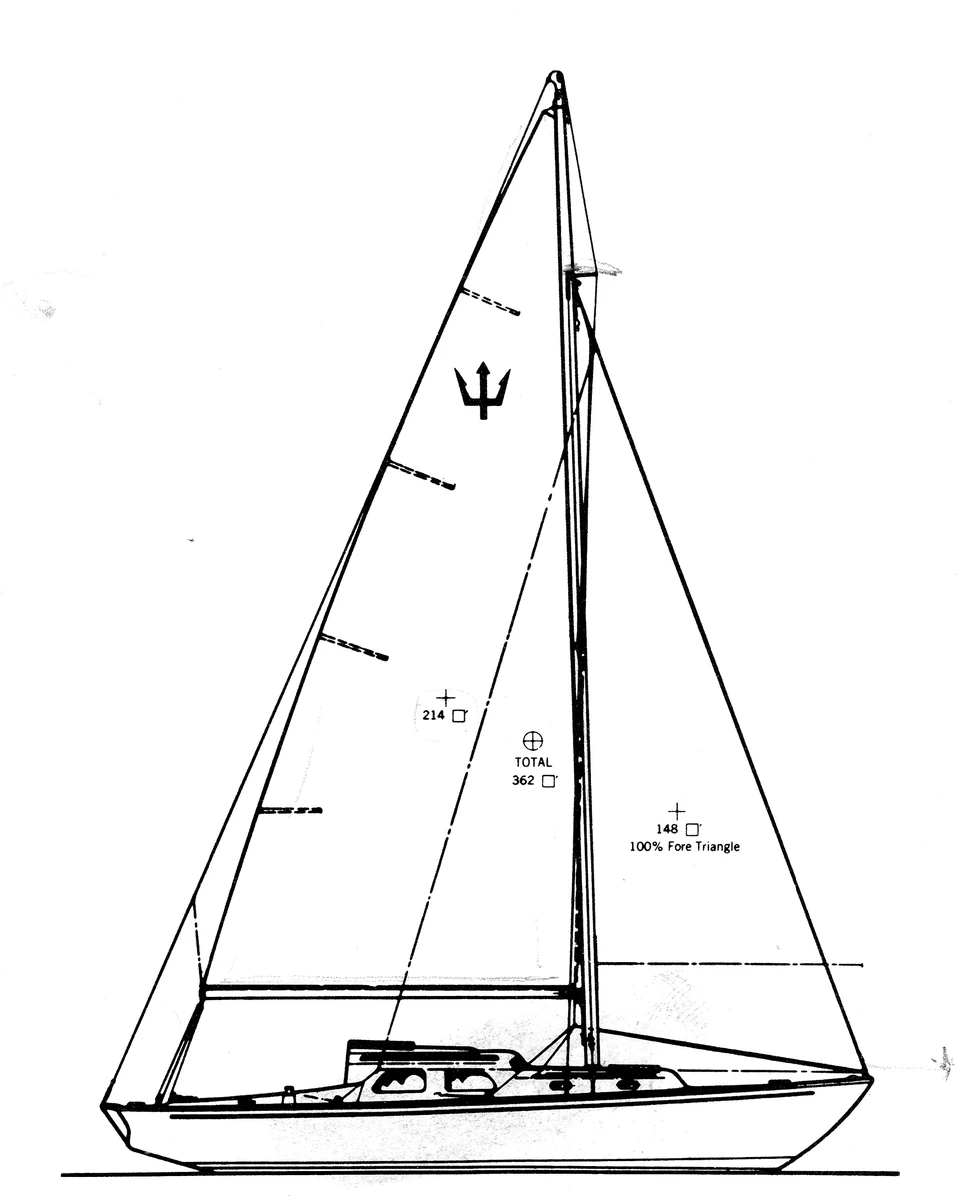
Pearson Triton 28 (fractional rig)
Description
The Pearson Triton 28 (Fractional Rig) is the iconic original configuration of Carl Alberg's groundbreaking fiberglass sailboat, launched in 1959 as an affordable racer-cruiser blending traditional lines with modern materials. This fractional sloop variant—distinguishing it from later masthead or yawl options—features a shorter mast (stepped on the deck) with the forestay attached about two-thirds up, allowing a larger mainsail relative to the headsail for balanced power and easier handling. With its long keel, spooned bow, and low freeboard inspired by Scandinavian Folkboats, it prioritizes seaworthiness and simplicity, sleeping four in a compact yet functional layout. Over 650 units were built by Pearson Yachts, cementing its status as a pioneer in mass-produced fiberglass boats under $10,000. Designed in 1958 at the request of broker Tom Potter for a durable coastal/offshore 28-footer, the Triton debuted at the 1959 New York Boat Show, where the prototype drew 17 orders in a single night. Pearson Yachts, founded by brothers Everett and Clinton Pearson in 1956, ramped up hand-laid fiberglass production in Portsmouth, Rhode Island, emphasizing quality amid the shift from wood to composites. The fractional rig was standard on early models, with yawl and masthead options added later; licensed builds in France (Jouët) and California (Aeromarine) stuck to sloops but varied in detail. Production ended in 1967 after ~700 total Tritons, but the design's affordability ($9,700 equipped) and performance fueled the small-boat revolution, earning induction into the American Sailboat Hall of Fame in 1995.
Construction Details
| Designer | Carl Alberg |
|---|---|
| Builder | Pearson Yachts |
| Length | 28.330 ft |
| LOA | 28.330 ft |
| LWL | 21.500 ft |
| Beam | 8.250 ft |
| Displacement | 6930 lb |
| Ballast | 3019 lb |
| Max Draft | 3.920 ft |
| Year Built | 1959 |
The standard boat dimensions
| i | 28.50 ft |
|---|---|
| j | 9.75 ft |
| p | 31 ft |
| e | 13 ft |
| p2 | - |
| e2 | - |
| i2 | - |
| j2 | - |
| I | J | P | E | P2 | E2 | I2 | J2 |
|---|---|---|---|---|---|---|---|
| 28.50 ft | 9.75 ft | 31 ft | 13 ft | - | - | - | - |
Blueprints
Sails
Pearson Triton 28 (fractional rig) - MAINSAIL
| Luff | * 33 ft - (10058 mm) |
|---|---|
| Foot | * 14 ft - (4267 mm) |
| Leech | * 35.11 ft - (10702 mm) |
| Tack Angle | * 88 ° |
| Diagonal | * 35.39 ft - (10787 mm) |
| Head (inches) | * 6 in - (152 mm) |
| Area | * 238.16 ft² |
| Edit in Calculator |
Pearson Triton 28 (fractional rig) - JIBSAIL
| Luff | * 24.1 ft - (7346 mm) |
|---|---|
| Foot | * 12.92 ft - (3938 mm) |
| Leech | * 22.11 ft - (6739 mm) |
| Percentage LP | * 120.51 % |
| Length Perpendicular | * 11.75 ft - (3581 mm) |
| Deck Angle | * 5.68 ° |
| Area | * 141.6 ft² |
| Edit in Calculator |
Pearson Triton 28 (fractional rig) - JIBSAIL
| Luff | 28 ft - (8534 mm) |
|---|---|
| Foot | 9.75 ft - (2972 mm) |
| Leech | 25 ft - (7620 mm) |
| Percentage LP | * 88.51 % |
| Length Perpendicular | * 8.63 ft - (2630 mm) |
| Deck Angle | * 8.84 ° |
| Area | * 120.82 ft² |
| Edit in Calculator |
Pearson Triton 28 (fractional rig) - JIBSAIL
| Luff | 28 ft - (8534 mm) |
|---|---|
| Foot | 11.25 ft - (3429 mm) |
| Leech | 25.5 ft - (7772 mm) |
| Percentage LP | * 105.03 % |
| Length Perpendicular | * 10.24 ft - (3121 mm) |
| Deck Angle | * 5.52 ° |
| Area | * 143.43 ft² |
| Edit in Calculator |
Pearson Triton 28 (fractional rig) - JIBSAIL
| Luff | 26 ft - (7925 mm) |
|---|---|
| Foot | 12.25 ft - (3734 mm) |
| Leech | 22.83 ft - (6959 mm) |
| Percentage LP | * 110.36 % |
| Length Perpendicular | * 10.76 ft - (3280 mm) |
| Deck Angle | * 9.71 ° |
| Area | * 139.83 ft² |
| Edit in Calculator |
Pearson Triton 28 (fractional rig) - JIBSAIL
| Luff | * 24.1 ft - (7346 mm) |
|---|---|
| Foot | * 13.06 ft - (3981 mm) |
| Leech | * 20.7 ft - (6309 mm) |
| Percentage LP | * 114.97 % |
| Length Perpendicular | * 11.21 ft - (3417 mm) |
| Deck Angle | * 11.97 ° |
| Area | * 135.09 ft² |
| Edit in Calculator |
Pearson Triton 28 (fractional rig) - GENOA
| Luff | 28.62 ft - (8723 mm) |
|---|---|
| Foot | 14.33 ft - (4368 mm) |
| Leech | 26.5 ft - (8077 mm) |
| Percentage LP | * 135.18 % |
| Length Perpendicular | * 13.18 ft - (4017 mm) |
| Deck Angle | * 4.24 ° |
| Area | * 188.58 ft² |
| Edit in Calculator |
Pearson Triton 28 (fractional rig) - GENOA
| Luff | 27.75 ft - (8458 mm) |
|---|---|
| Foot | 15.67 ft - (4776 mm) |
| Leech | 26.33 ft - (8025 mm) |
| Percentage LP | * 149.23 % |
| Length Perpendicular | * 14.55 ft - (4435 mm) |
| Deck Angle | * 2.87 ° |
| Area | * 201.94 ft² |
| Edit in Calculator |
Pearson Triton 28 (fractional rig) - GENOA
| Luff | 28.75 ft - (8763 mm) |
|---|---|
| Foot | 16 ft - (4877 mm) |
| Leech | 27.75 ft - (8458 mm) |
| Percentage LP | * 154.36 % |
| Length Perpendicular | * 15.05 ft - (4587 mm) |
| Deck Angle | * 0.97 ° |
| Area | * 216.32 ft² |
| Edit in Calculator |
Pearson Triton 28 (fractional rig) - GENOA
| Luff | * 28.62 ft - (8723 mm) |
|---|---|
| Foot | * 15.87 ft - (4837 mm) |
| Leech | * 26.79 ft - (8166 mm) |
| Percentage LP | * 149.95 % |
| Length Perpendicular | * 14.62 ft - (4456 mm) |
| Deck Angle | * 4 ° |
| Area | * 209.22 ft² |
| Edit in Calculator |
Pearson Triton 28 (fractional rig) - GENOA
| Luff | 27.75 ft - (8458 mm) |
|---|---|
| Foot | 18 ft - (5486 mm) |
| Leech | 26.5 ft - (8077 mm) |
| Percentage LP | * 169.85 % |
| Length Perpendicular | * 16.56 ft - (5047 mm) |
| Deck Angle | * 4.21 ° |
| Area | * 229.74 ft² |
| Edit in Calculator |
Pearson Triton 28 (fractional rig) - DRIFTER
| Luff | 28.62 ft - (8723 mm) |
|---|---|
| Foot | 16.5 ft - (5029 mm) |
| Leech | 26 ft - (7925 mm) |
| Perc LP | * 152 % |
| Length Perp | * 14.82 ft - (4517 mm) |
| Deck Angle | * 7.2 ° |
| Area | * 212.06 ft² |
| Edit in Calculator |
Pearson Triton 28 (fractional rig) - ASYMMETRICAL
| Luff | 29 ft - (8839 mm) |
|---|---|
| Foot | 17 ft - (5182 mm) |
| Leech | 26.75 ft - (8153 mm) |
| Perc LP | * 165 % |
| Area | * 370 ft² |
| Edit in Calculator |
Disclaimer. Boats are not all the same -- even when produced in the same factory of the same model. Sailrite does its best to publish accurate dimensions, but we often find it worthwhile to have our customers measure their boats carefully before we produce kits for them. You should take the same precautions, especially when the data is not from Sailrite. The information on this site is not guaranteed to be accurate. Sailrite offers this content as a service to our community, but takes no responsibility for the reliability of the data provided.
Comments


