

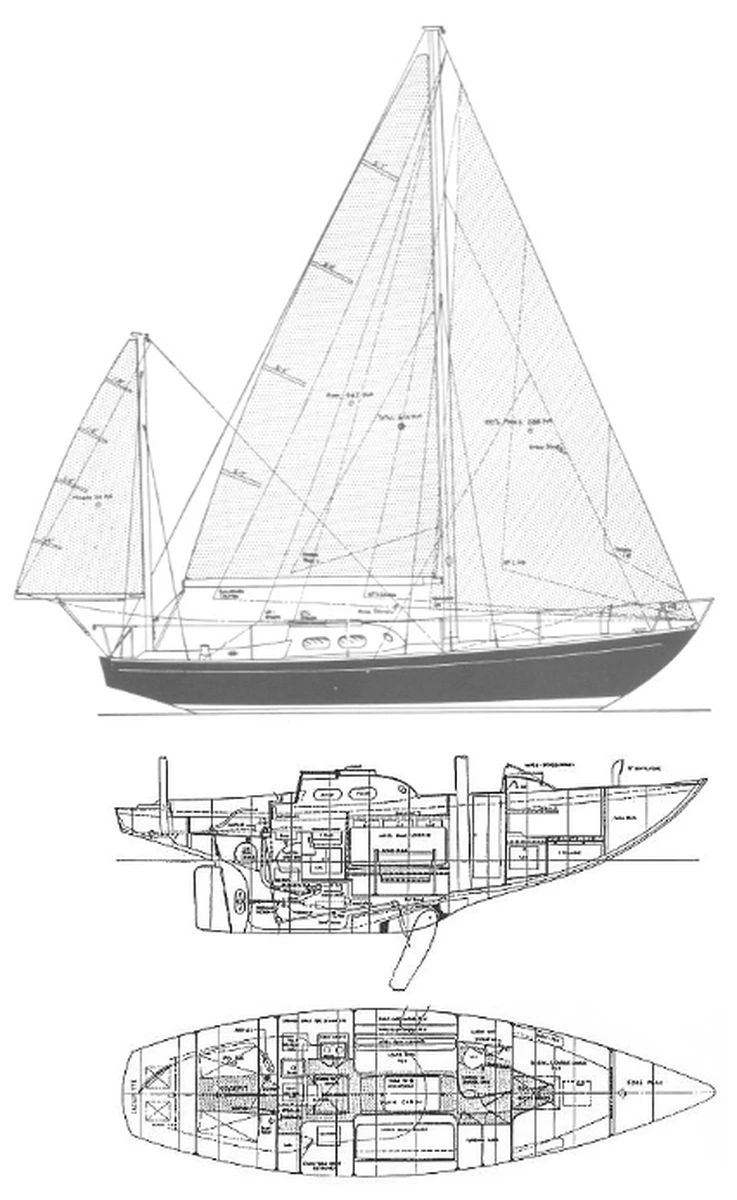
Pearson Invicta (yawl rig)
Description
The Pearson Invicta (Yawl Rig) is a groundbreaking fiberglass ocean racer-cruiser designed by William H. "Bill" Tripp Jr. for Pearson Yachts, produced from 1961 to 1969 as a masthead yawl with a keel/centerboard hull emphasizing balanced sail handling, light-air speed, and offshore stability. Featuring a divided rig for reduced weather helm in gales, a skeg-hung rudder for protection, and a flush-deck layout optimized for racing crews, it sleeps four to six in a spartan yet functional interior, powered by a Universal Atomic 4 gasoline inboard. At around $20,000–$25,000 new, the yawl variant (~10–15 of 28 total Invictas) targeted ambitious sailors, with its tank-tested hull proving revolutionary—Burgoo became the first fiberglass boat to win the Newport to Bermuda Race in 1964 (first in Class E, second overall corrected). Tripp, a Sparkman & Stephens protégé, developed the Invicta in 1960 at Stevens Institute, refining a lightweight, fine-ended hull for CCA rules to excel in midget ocean racing while offering cruising versatility; the yawl rig was a factory option for better balance and easier reefing. Debuting in 1961 from Pearson's Portsmouth, Rhode Island facility (Grumman-owned), production totaled 28 units through 1969, hand-laid in solid fiberglass with mahogany trim for durability amid the wood-to-composite shift. The yawl Burgoo etched history: first in Class E (second overall) at the 1962 Bermuda Race, third in the 1963 Halifax Race, and outright winner of the 1964 Newport-Bermuda (also transatlantic in 1966)—validating fiberglass for elite offshore events. A refined Invicta II followed in 1964 with an extended coach roof, but the original yawl remains a collector's prize via the Pearson Yachts Owners Portal.
Construction Details
| Designer | William H. Tripp Jr. |
|---|---|
| Builder | Pearson Yachts |
| Length | 37.900 ft |
| LOA | 37.900 ft |
| LWL | 25.000 ft |
| Beam | 10.700 ft |
| Displacement | 19000 lb |
| Ballast | 7600 lb |
| Max Draft | 7.700 ft |
| Min Draft | 4.500 ft |
| Year Built | 1961 |
The standard boat dimensions
| i | 38.50 ft |
|---|---|
| j | 15.20 ft |
| p | 33 ft |
| e | 16.10 ft |
| p2 | 16 ft |
| e2 | 8.20 ft |
| i2 | - |
| j2 | - |
| I | J | P | E | P2 | E2 | I2 | J2 |
|---|---|---|---|---|---|---|---|
| 38.50 ft | 15.20 ft | 33 ft | 16.10 ft | 16 ft | 8.20 ft | - | - |
Sails
Pearson Invicta (yawl rig) - MAINSAIL
| Luff | * 33 ft - (10058 mm) |
|---|---|
| Foot | * 16.1 ft - (4907 mm) |
| Leech | * 35.92 ft - (10948 mm) |
| Tack Angle | * 88 ° |
| Diagonal | * 36.21 ft - (11037 mm) |
| Head (inches) | * 6 in - (152 mm) |
| Area | * 272.83 ft² |
| Edit in Calculator |
Pearson Invicta (yawl rig) - JIBSAIL
| Luff | * 33.11 ft - (10092 mm) |
|---|---|
| Foot | * 20.97 ft - (6392 mm) |
| Leech | * 27.73 ft - (8452 mm) |
| Percentage LP | * 115 % |
| Length Perpendicular | * 17.48 ft - (5328 mm) |
| Deck Angle | * 11.99 ° |
| Area | * 289.39 ft² |
| Edit in Calculator |
Pearson Invicta (yawl rig) - GENOA
| Luff | * 39.32 ft - (11985 mm) |
|---|---|
| Foot | * 25.27 ft - (7702 mm) |
| Leech | * 36.44 ft - (11107 mm) |
| Percentage LP | * 150 % |
| Length Perpendicular | * 22.8 ft - (6949 mm) |
| Deck Angle | * 4 ° |
| Area | * 448.26 ft² |
| Edit in Calculator |
Pearson Invicta (yawl rig) - MIZZEN
| Luff | * 16 ft - (4877 mm) |
|---|---|
| Foot | * 8.2 ft - (2499 mm) |
| Leech-AftHdBd | * 17.68 ft - (5389 mm) |
| Tack Ang | * 87.98 ° |
| Diag (clew/head) | * 17.72 ft - (5401 mm) |
| Head (inches) | * 3.5 in - (89 mm) |
| Area (no Roach) | * 68.12 ft² |
| Edit in Calculator |
Disclaimer. Boats are not all the same -- even when produced in the same factory of the same model. Sailrite does its best to publish accurate dimensions, but we often find it worthwhile to have our customers measure their boats carefully before we produce kits for them. You should take the same precautions, especially when the data is not from Sailrite. The information on this site is not guaranteed to be accurate. Sailrite offers this content as a service to our community, but takes no responsibility for the reliability of the data provided.
Comments


