

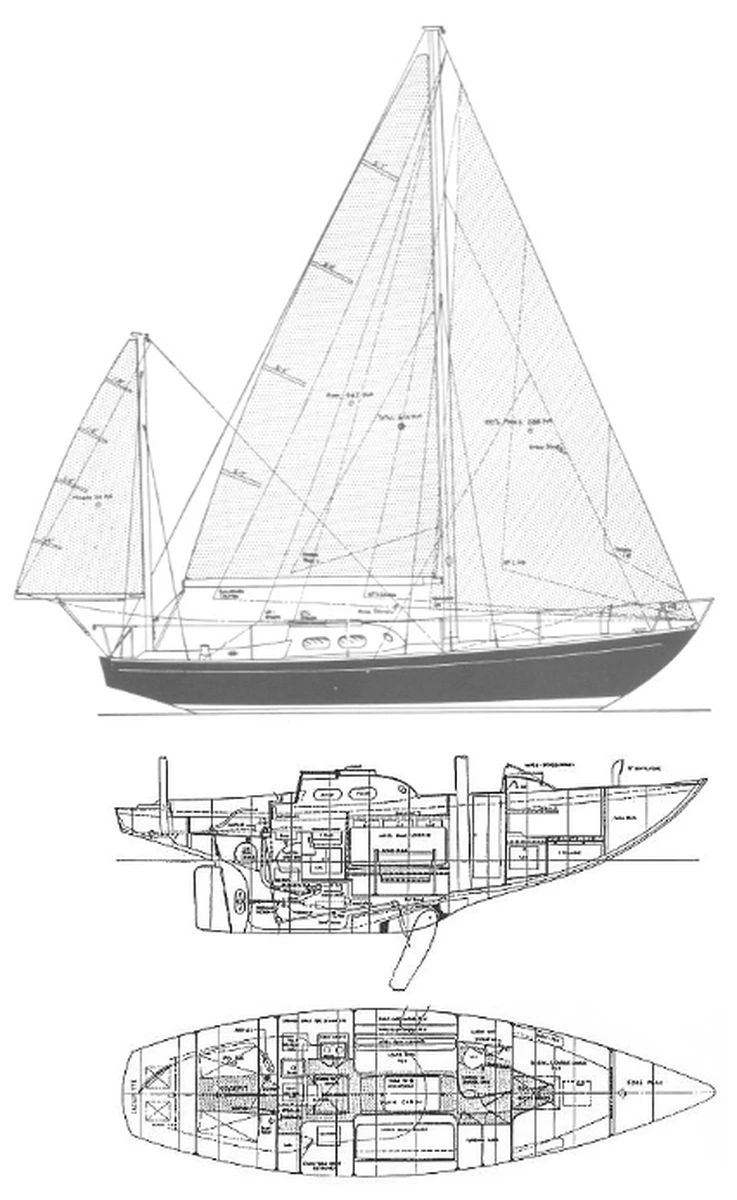
Pearson Invicta II (yawl rig)
Description
The Pearson Invicta II (Yawl Rig) is a classic fiberglass ocean racer-cruiser designed by William H. "Bill" Tripp for Pearson Yachts, produced from 1964 to 1969 as a masthead yawl emphasizing balanced heavy-weather handling and light-air performance with a keel/centerboard hull for versatility in shallow waters or offshore races. Evolving from the original 1961 Invicta with an extended coach roof for improved interior volume and headroom, it features a generous sail plan (main + mizzen ~353 ft² foretriangle ~311 ft²), skeg-hung rudder for protection, and accommodations for six in a practical layout, powered by a Universal Atomic 4 gasoline engine. At around $25,000 new, it targeted serious sailors blending Tripp's innovative lines—tank-tested at Stevens Institute—with Pearson's durable hand-laid construction, marking an early milestone in fiberglass bluewater capability. Designed by Tripp as an update to his groundbreaking Invicta (which debuted in 1961 and won Class E in the 1962 Bermuda Race), the Invicta II incorporated hull refinements for better stability, a flush-to-coach-roof deck transition, and optional yawl rig for divided sail power and reduced helm in gales. Built exclusively by Pearson Yachts in Portsmouth, Rhode Island (under Grumman ownership), production was limited to 12 units through 1969, with the yawl configuration favored for racing (both sloop and yawl available). The yawl Burgoo made history as the first fiberglass boat to win the Newport-to-Bermuda Race in 1964 (first in Class E, second overall corrected), also placing third in the 1963 Halifax Race and racing transatlantic in 1966—proving the design's mettle. Total Invicta variants reached ~28-40, but the II's scarcity enhances its collectible status today via the Pearson Yachts Owners Portal.
Construction Details
| Designer | William H. Tripp |
|---|---|
| Builder | Pearson Yachts |
| Length | 37.670 ft |
| LOA | 37.670 ft |
| LWL | 25.000 ft |
| Beam | 10.600 ft |
| Displacement | 17750 lb |
| Ballast | 5650 lb |
| Max Draft | 8.600 ft |
| Min Draft | 4.500 ft |
| Year Built | 1964 |
The standard boat dimensions
| i | 39.75 ft |
|---|---|
| j | 15.13 ft |
| p | 35 ft |
| e | 16 ft |
| p2 | 17 ft |
| e2 | 7.75 ft |
| i2 | - |
| j2 | - |
| I | J | P | E | P2 | E2 | I2 | J2 |
|---|---|---|---|---|---|---|---|
| 39.75 ft | 15.13 ft | 35 ft | 16 ft | 17 ft | 7.75 ft | - | - |
Documents
Blueprints
Sails
Pearson Invicta II (yawl rig) - MAINSAIL
| Luff | * 35 ft - (10668 mm) |
|---|---|
| Foot | * 16 ft - (4877 mm) |
| Leech | * 37.68 ft - (11485 mm) |
| Tack Angle | * 88 ° |
| Diagonal | * 37.97 ft - (11573 mm) |
| Head (inches) | * 6 in - (152 mm) |
| Area | * 287.53 ft² |
| Edit in Calculator |
Pearson Invicta II (yawl rig) - JIBSAIL
| Luff | * 19.1 ft - (5822 mm) |
|---|---|
| Foot | * 10.8 ft - (3292 mm) |
| Leech | * 16.29 ft - (4965 mm) |
| Percentage LP | * 115 % |
| Length Perpendicular | * 9.2 ft - (2804 mm) |
| Deck Angle | * 12.01 ° |
| Area | * 87.86 ft² |
| Edit in Calculator |
Pearson Invicta II (yawl rig) - GENOA
| Luff | 39.5 ft - (12040 mm) |
|---|---|
| Foot | 21.75 ft - (6629 mm) |
| Leech | 36.25 ft - (11049 mm) |
| Percentage LP | * 130.54 % |
| Length Perpendicular | * 19.75 ft - (6020 mm) |
| Deck Angle | * 3.91 ° |
| Area | * 390.12 ft² |
| Edit in Calculator |
Pearson Invicta II (yawl rig) - GENOA
| Luff | * 40.41 ft - (12317 mm) |
|---|---|
| Foot | * 25.01 ft - (7623 mm) |
| Leech | * 37.55 ft - (11445 mm) |
| Percentage LP | * 150.03 % |
| Length Perpendicular | * 22.7 ft - (6919 mm) |
| Deck Angle | * 3.98 ° |
| Area | * 458.65 ft² |
| Edit in Calculator |
Pearson Invicta II (yawl rig) - MIZZEN
| Tack Ang | * 88 ° |
|---|---|
| Head (inches) | * 3.5 in - (89 mm) |
| Area (no Roach) | 65.78 ft² |
| Edit in Calculator |
Pearson Invicta II (yawl rig) - STORMJIB
| Luff | * 23.39 ft - (7129 mm) |
|---|---|
| Foot | * 11.82 ft - (3603 mm) |
| Leech | * 18.24 ft - (5560 mm) |
| Perc LP | * 60.01 % |
| Length Perp | * 9.08 ft - (2768 mm) |
| Deck Angle | * 18.98 ° |
| Area | * 106.17 ft² |
| Edit in Calculator |
Disclaimer. Boats are not all the same -- even when produced in the same factory of the same model. Sailrite does its best to publish accurate dimensions, but we often find it worthwhile to have our customers measure their boats carefully before we produce kits for them. You should take the same precautions, especially when the data is not from Sailrite. The information on this site is not guaranteed to be accurate. Sailrite offers this content as a service to our community, but takes no responsibility for the reliability of the data provided.
Comments


