

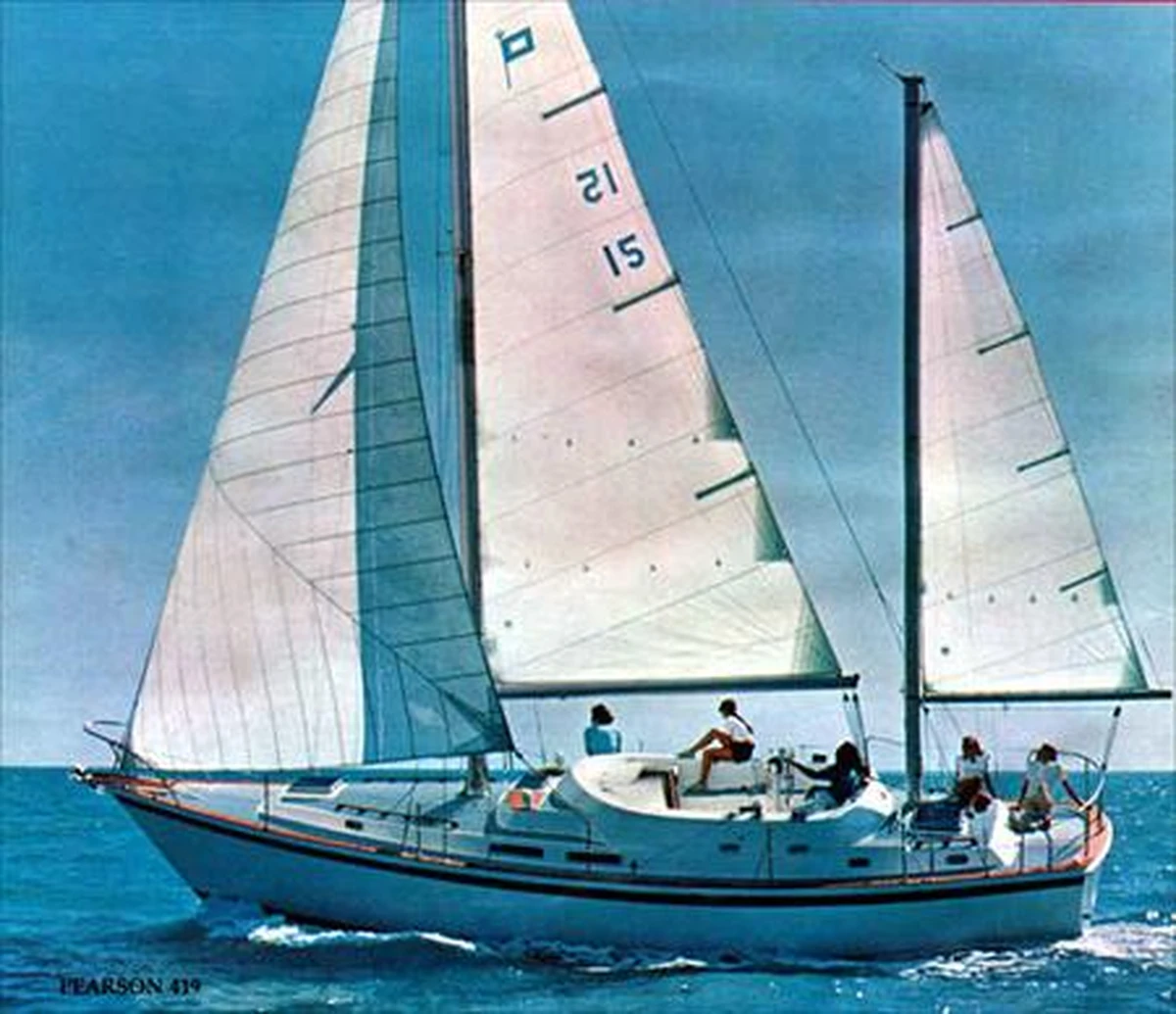
Pearson 419 (ketch rig)
Description
The Pearson 419 Ketch is a center-cockpit cruising sailboat optimized for charter operations and bluewater family voyages, featuring a divided ketch rig for simplified short-handed handling and balanced sail power in trade winds. Built on a beamy hull shared with the aft-cockpit 424, it offers substantial interior volume, stability, and privacy with a separated aft stateroom, making it ideal for couples or small groups on Caribbean or transatlantic passages. The fin keel and skeg-hung rudder provide responsive yet protected steering, while the ketch configuration—shorter main mast and compact mizzen—eases reefing without sacrificing drive. Owners commend its easy motion in slop, luxurious teak accommodations for 6-7, and charter-proven durability, though its modest performance suits relaxed cruising over racing. As a 50-year-old classic, the ketch variant (most common) commands a premium for its versatility. Designed by William H. Shaw in 1974, the Pearson 419 launched in 1975 as a center-cockpit ketch tailored for the booming charter market, competing with models like the Morgan Out Island 41 for tropical fleet use in the Bahamas and Virgin Islands. Shaw, Pearson's lead designer with roots at Sparkman & Stephens, prioritized low-maintenance seaworthiness and volume for guest comfort, evolving from the 390 with a beamier hull and optional sloop rig (rarer). Produced by Pearson Yachts in Portsmouth, Rhode Island, from 1975 to 1976, only about 20-25 hulls were built—predominantly ketches for their ease in gusty trades; sloops were a minority option for lighter winds. The brief run reflected a pivot to aft-cockpit designs like the 424. The Pearson Yachts Owners Portal (pearsonyachts.org) and Cruisers Forum threads sustain the community, with many 419s still chartering or crossing oceans.
Construction Details
| Designer | William H. "Bill" Shaw |
|---|---|
| Builder | Pearson Yachts |
| Length | 41.800 ft |
| LOA | 41.800 ft |
| LWL | 33.700 ft |
| Beam | 13.000 ft |
| Displacement | 21000 lb |
| Ballast | 7634 lb |
| Max Draft | 5.300 ft |
| Year Built | 1975 |
The standard boat dimensions
| i | 45 ft |
|---|---|
| j | 15.75 ft |
| p | 38 ft |
| e | 14.50 ft |
| p2 | 23 ft |
| e2 | 8.75 ft |
| i2 | - |
| j2 | - |
| I | J | P | E | P2 | E2 | I2 | J2 |
|---|---|---|---|---|---|---|---|
| 45 ft | 15.75 ft | 38 ft | 14.50 ft | 23 ft | 8.75 ft | - | - |
Sails
Pearson 419 (ketch rig) - MAINSAIL
| Luff | * 38 ft - (11582 mm) |
|---|---|
| Foot | * 14.5 ft - (4420 mm) |
| Leech | * 39.92 ft - (12168 mm) |
| Tack Angle | * 88 ° |
| Diagonal | * 40.2 ft - (12253 mm) |
| Head (inches) | * 6 in - (152 mm) |
| Area | * 283.63 ft² |
| Edit in Calculator |
Pearson 419 (ketch rig) - JIBSAIL
| Luff | * 38.14 ft - (11625 mm) |
|---|---|
| Foot | * 21.19 ft - (6459 mm) |
| Leech | * 32.63 ft - (9946 mm) |
| Percentage LP | * 114.98 % |
| Length Perpendicular | * 18.11 ft - (5520 mm) |
| Deck Angle | * 11.98 ° |
| Area | * 345.4 ft² |
| Edit in Calculator |
Pearson 419 (ketch rig) - GENOA
| Luff | 44 ft - (13411 mm) |
|---|---|
| Foot | 26 ft - (7925 mm) |
| Leech | 40.75 ft - (12421 mm) |
| Percentage LP | * 150.16 % |
| Length Perpendicular | * 23.65 ft - (7209 mm) |
| Deck Angle | * 5.28 ° |
| Area | * 520.2 ft² |
| Edit in Calculator |
Pearson 419 (ketch rig) - GENOA
| Luff | * 45.29 ft - (13804 mm) |
|---|---|
| Foot | * 25.72 ft - (7839 mm) |
| Leech | * 42.32 ft - (12899 mm) |
| Percentage LP | * 149.97 % |
| Length Perpendicular | * 23.62 ft - (7199 mm) |
| Deck Angle | * 4.02 ° |
| Area | * 534.91 ft² |
| Edit in Calculator |
Pearson 419 (ketch rig) - MIZZEN
| Luff | * 23 ft - (7010 mm) |
|---|---|
| Foot | * 8.75 ft - (2667 mm) |
| Leech-AftHdBd | * 24.09 ft - (7343 mm) |
| Tack Ang | * 87.99 ° |
| Diag (clew/head) | * 24.32 ft - (7413 mm) |
| Head (inches) | * 4 in - (102 mm) |
| Area (no Roach) | * 103.48 ft² |
| Edit in Calculator |
Disclaimer. Boats are not all the same -- even when produced in the same factory of the same model. Sailrite does its best to publish accurate dimensions, but we often find it worthwhile to have our customers measure their boats carefully before we produce kits for them. You should take the same precautions, especially when the data is not from Sailrite. The information on this site is not guaranteed to be accurate. Sailrite offers this content as a service to our community, but takes no responsibility for the reliability of the data provided.
Comments


