

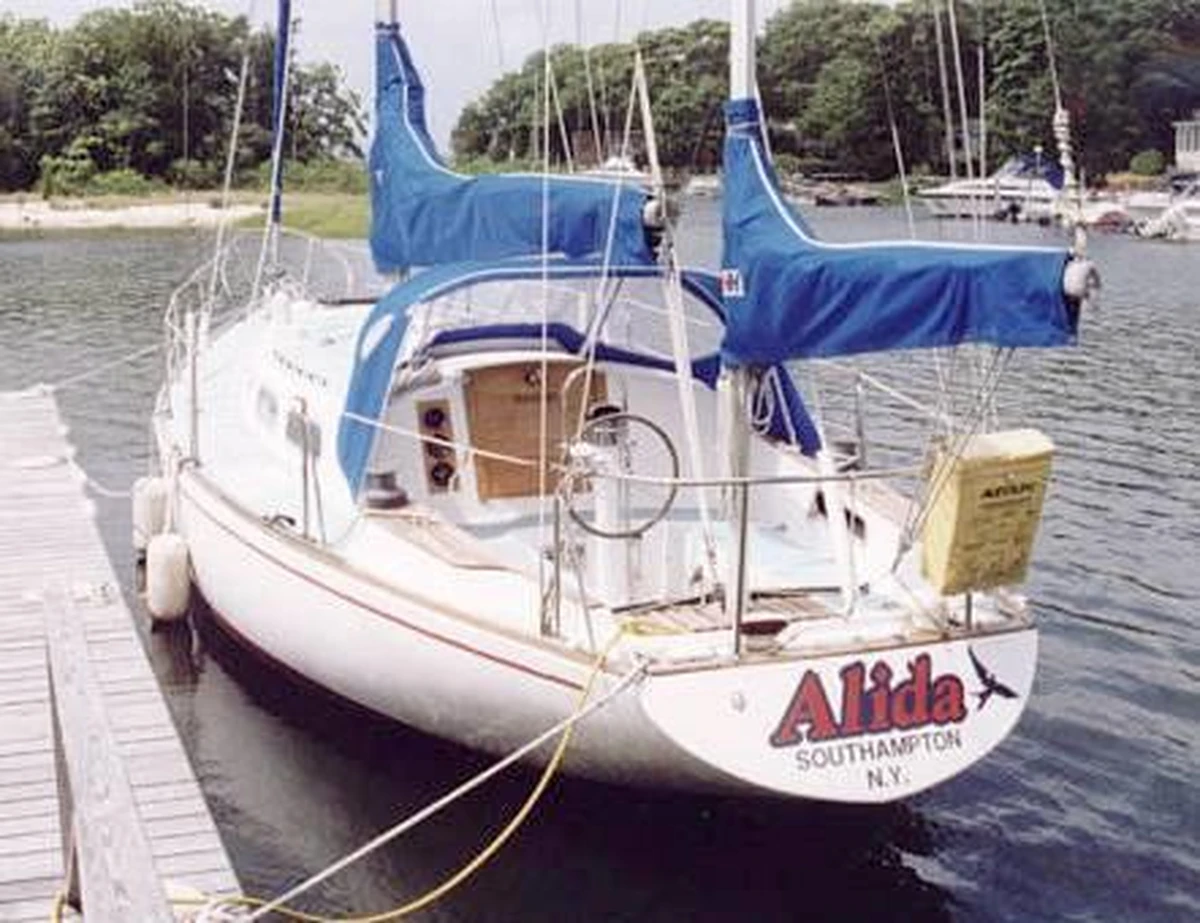
Pearson 39 (yawl rig)
Description
The Pearson 39 Yawl is a versatile fiberglass keel/centerboard cruiser designed for balanced performance in both racing and family cruising, with a divided yawl rig that enhances short-handed handling and reduces weather helm. Built on a heavy-displacement hull with a skeg-hung rudder, it offers shallow-draft accessibility (board up) for harbor exploration while providing offshore stability and a spacious, teak-trimmed interior. As a yawl variant of the popular Pearson 39, it appeals to traditional sailors seeking a "racer that cruises" with easy motion and quick acceleration—ideal for coastal passages or occasional bluewater adventures. Designed by William (Bill) Shaw and introduced in 1970 by Pearson Yachts in Portsmouth, Rhode Island, the Pearson 39 was produced until 1977 (some sources cite 1978), with approximately 150 units built across sloop and yawl configurations. The yawl rig was a popular option for its versatility, comprising a notable portion of production. An updated Pearson 39-2 followed from 1986 to 1991 (and briefly in 1997), but the original emphasized Shaw's focus on moderate-aspect rigs for stability. Tank-tested for performance, it earned racing trophies while serving as a family cruiser, reflecting Pearson's blend of speed and comfort before the yard's 1991 closure.
Construction Details
| Designer | William H. "Bill" Shaw |
|---|---|
| Builder | Pearson Yachts |
| Length | 39.250 ft |
| LOA | 39.250 ft |
| LWL | 30.000 ft |
| Beam | 11.670 ft |
| Displacement | 17000 lb |
| Ballast | 7300 lb |
| Max Draft | 4.640 ft |
| Year Built | 1970 |
The standard boat dimensions
| i | 46.50 ft |
|---|---|
| j | 16.17 ft |
| p | 41 ft |
| e | 14.50 ft |
| p2 | 20 ft |
| e2 | 6.50 ft |
| i2 | - |
| j2 | - |
| I | J | P | E | P2 | E2 | I2 | J2 |
|---|---|---|---|---|---|---|---|
| 46.50 ft | 16.17 ft | 41 ft | 14.50 ft | 20 ft | 6.50 ft | - | - |
Sails
Pearson 39 (yawl rig) - MAINSAIL
| Luff | * 41 ft - (12497 mm) |
|---|---|
| Foot | * 14.5 ft - (4420 mm) |
| Leech | * 42.73 ft - (13024 mm) |
| Tack Angle | * 88 ° |
| Diagonal | * 43.01 ft - (13109 mm) |
| Head (inches) | * 6 in - (152 mm) |
| Area | * 305.95 ft² |
| Edit in Calculator |
Pearson 39 (yawl rig) - JIBSAIL
| Luff | * 39.39 ft - (12006 mm) |
|---|---|
| Foot | * 21.74 ft - (6626 mm) |
| Leech | * 33.73 ft - (10281 mm) |
| Percentage LP | * 115.03 % |
| Length Perpendicular | * 18.6 ft - (5669 mm) |
| Deck Angle | * 12 ° |
| Area | * 366.35 ft² |
| Edit in Calculator |
Pearson 39 (yawl rig) - GENOA
| Luff | * 46.77 ft - (14255 mm) |
|---|---|
| Foot | * 26.39 ft - (8044 mm) |
| Leech | * 43.73 ft - (13329 mm) |
| Percentage LP | * 150.03 % |
| Length Perpendicular | * 24.26 ft - (7394 mm) |
| Deck Angle | * 4 ° |
| Area | * 567.32 ft² |
| Edit in Calculator |
Pearson 39 (yawl rig) - GENOA
| Luff | 45.25 ft - (13792 mm) |
|---|---|
| Foot | 23.75 ft - (7239 mm) |
| Leech | 42 ft - (12802 mm) |
| Percentage LP | * 135 % |
| Length Perpendicular | * 21.83 ft - (6654 mm) |
| Deck Angle | * 4.05 ° |
| Area | * 493.8 ft² |
| Edit in Calculator |
Pearson 39 (yawl rig) - ASYMMETRICAL
| Luff | 47 ft - (14326 mm) |
|---|---|
| Foot | 27 ft - (8230 mm) |
| Leech | 44 ft - (13411 mm) |
| Perc LP | * 165 % |
| Area | * 952 ft² |
| Edit in Calculator |
Pearson 39 (yawl rig) - MIZZEN
| Luff | * 20 ft - (6096 mm) |
|---|---|
| Foot | * 6.5 ft - (1981 mm) |
| Leech-AftHdBd | * 20.57 ft - (6270 mm) |
| Tack Ang | * 87.97 ° |
| Diag (clew/head) | * 20.81 ft - (6343 mm) |
| Head (inches) | * 3.5 in - (89 mm) |
| Area (no Roach) | * 66.67 ft² |
| Edit in Calculator |
Disclaimer. Boats are not all the same -- even when produced in the same factory of the same model. Sailrite does its best to publish accurate dimensions, but we often find it worthwhile to have our customers measure their boats carefully before we produce kits for them. You should take the same precautions, especially when the data is not from Sailrite. The information on this site is not guaranteed to be accurate. Sailrite offers this content as a service to our community, but takes no responsibility for the reliability of the data provided.
Comments


