

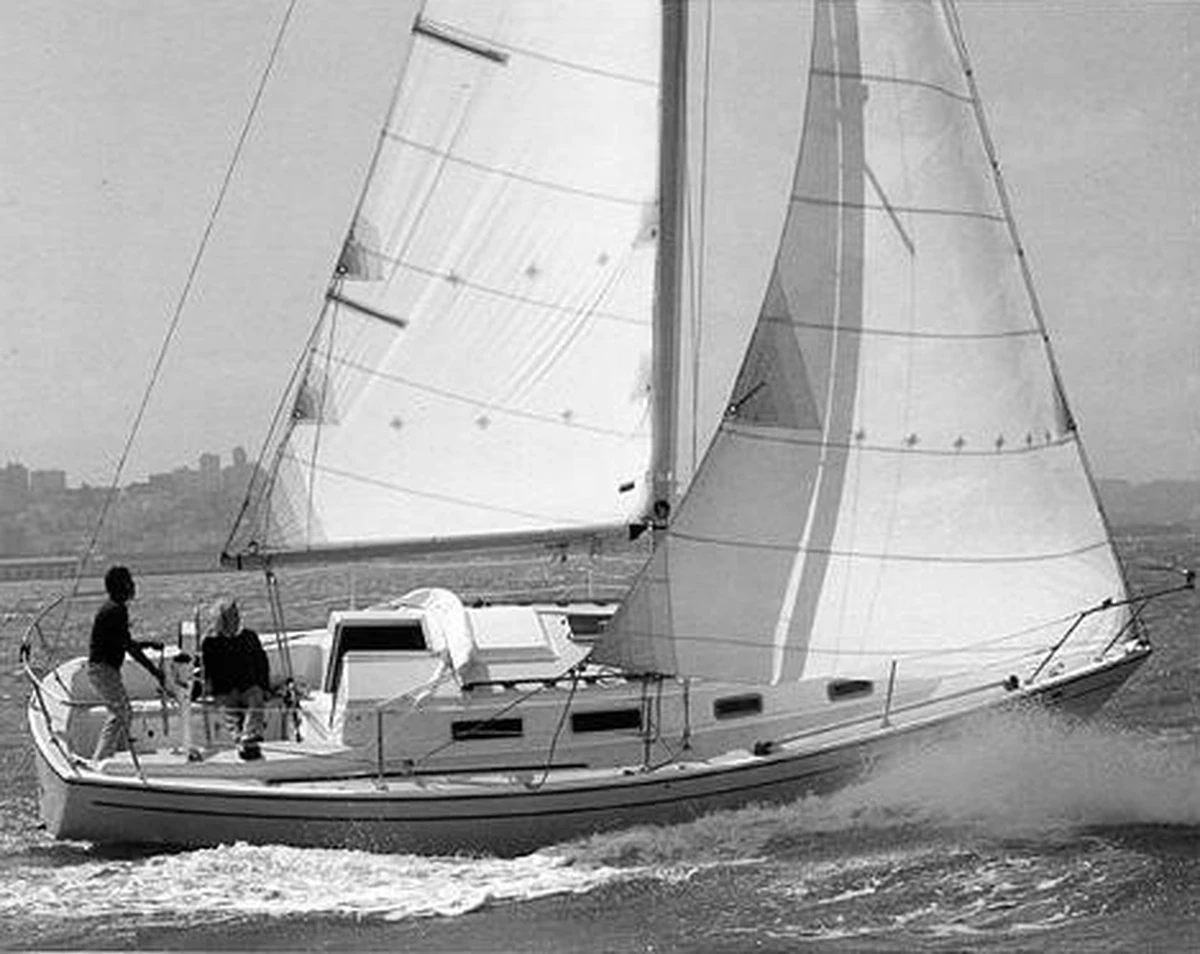
Pearson 303
Description
The Pearson 303 is a fiberglass racer-cruiser designed by William H. "Bill" Shaw for Pearson Yachts, produced from 1982 to 1985 as a compact, high-performance sloop emphasizing agile handling and surprising interior volume in a 30-foot package. Featuring a masthead rig, fin keel (with optional shoal draft), and spade rudder for responsive steering, it balances club racing speed with coastal cruising comfort, sleeping five in a linear layout with a focus on shorthanded ease. Powered by a reliable Yanmar diesel and built with solid hand-laid hulls (balsa-cored decks), it was priced around $40,000 new, appealing to sailors seeking a lively, low-maintenance alternative to heavier cruisers of the era. Bill Shaw, Pearson's veteran designer, created the 303 as an evolution of his Pearson 30 and 323, incorporating IOR-inspired lines for better upwind performance while prioritizing build quality during Pearson's later Grumman-owned years. Debuting in 1982 at Portsmouth, Rhode Island, it targeted the growing one-design and PHRF racing market, with production totaling about 60 units over three years—hand-laid for durability amid the fiberglass industry's maturation. A shoal-draft variant (4.0 ft) was offered for shallow-water access, but no ketch or yawl options existed; the model earned quick acclaim in reviews for its "pocket rocket" feel, though limited output reflected Pearson's shift toward larger boats like the 38. Today, a dedicated fleet thrives via the Pearson Owners Association, with many upgraded for modern racing.
Construction Details
| Designer | William H. "Bill" Shaw |
|---|---|
| Builder | Pearson Yachts |
| Length | 30.300 ft |
| LOA | 30.300 ft |
| LWL | 25.400 ft |
| Beam | 10.920 ft |
| Displacement | 10400 lb |
| Ballast | 3500 lb |
| Max Draft | 4.300 ft |
| Year Built | 982 |
The standard boat dimensions
| i | 40.44 ft |
|---|---|
| j | 13.35 ft |
| p | 34.75 ft |
| e | 10.75 ft |
| p2 | - |
| e2 | - |
| i2 | - |
| j2 | - |
| I | J | P | E | P2 | E2 | I2 | J2 |
|---|---|---|---|---|---|---|---|
| 40.44 ft | 13.35 ft | 34.75 ft | 10.75 ft | - | - | - | - |
Blueprints
Sails
Pearson 303 - MAINSAIL
| Luff | * 34.75 ft - (10592 mm) |
|---|---|
| Foot | * 10.75 ft - (3277 mm) |
| Leech | * 35.81 ft - (10915 mm) |
| Tack Angle | * 88 ° |
| Diagonal | * 36.01 ft - (10976 mm) |
| Head (inches) | * 4.5 in - (114 mm) |
| Area | * 192.36 ft² |
| Edit in Calculator |
Pearson 303 - JIBSAIL
| Luff | 40 ft - (12192 mm) |
|---|---|
| Foot | 16 ft - (4877 mm) |
| Leech | 37 ft - (11278 mm) |
| Percentage LP | * 110.86 % |
| Length Perpendicular | * 14.8 ft - (4511 mm) |
| Deck Angle | * 4.09 ° |
| Area | * 295.93 ft² |
| Edit in Calculator |
Pearson 303 - GENOA
| Luff | 39.75 ft - (12116 mm) |
|---|---|
| Foot | 21.5 ft - (6553 mm) |
| Leech | 37.75 ft - (11506 mm) |
| Percentage LP | * 150.19 % |
| Length Perpendicular | * 20.05 ft - (6111 mm) |
| Deck Angle | * 2.9 ° |
| Area | * 398.48 ft² |
| Edit in Calculator |
Pearson 303 - GENOA
| Luff | 39.25 ft - (11963 mm) |
|---|---|
| Foot | 19.5 ft - (5944 mm) |
| Leech | 36.58 ft - (11150 mm) |
| Percentage LP | * 135.06 % |
| Length Perpendicular | * 18.03 ft - (5496 mm) |
| Deck Angle | * 4.11 ° |
| Area | * 353.87 ft² |
| Edit in Calculator |
Pearson 303 - GENOA
| Luff | * 40.46 ft - (12332 mm) |
|---|---|
| Foot | * 21.63 ft - (6593 mm) |
| Leech | * 37.98 ft - (11576 mm) |
| Percentage LP | * 149.96 % |
| Length Perpendicular | * 20.02 ft - (6102 mm) |
| Deck Angle | * 3.97 ° |
| Area | * 405.03 ft² |
| Edit in Calculator |
Pearson 303 - DRIFTER
| Luff | 40.5 ft - (12344 mm) |
|---|---|
| Foot | 22.75 ft - (6934 mm) |
| Leech | 36.25 ft - (11049 mm) |
| Perc LP | * 151.54 % |
| Length Perp | * 20.23 ft - (6166 mm) |
| Deck Angle | * 8.98 ° |
| Area | * 409.56 ft² |
| Edit in Calculator |
Pearson 303 - ASYMMETRICAL
| Luff | 41 ft - (12497 mm) |
|---|---|
| Foot | 23 ft - (7010 mm) |
| Leech | 38 ft - (11582 mm) |
| Perc LP | * 165 % |
| Area | * 707 ft² |
| Edit in Calculator |
Pearson 303 - SPINNAKER
| Stays | * 40.46 ft - (12332 mm) |
|---|---|
| MidGirth | * 24.03 ft - (7324 mm) |
| Foot | * 24.03 ft - (7324 mm) |
| Perc LP | * 180 % |
| Area | * 826 ft² |
| Edit in Calculator |
Pearson 303 - STORMJIB
| Luff | * 23.42 ft - (7138 mm) |
|---|---|
| Foot | * 10.07 ft - (3069 mm) |
| Leech | * 19.08 ft - (5816 mm) |
| Perc LP | * 60 % |
| Length Perp | * 8.01 ft - (2441 mm) |
| Deck Angle | * 19.03 ° |
| Area | * 93.8 ft² |
| Edit in Calculator |
Pearson 303 - STORMTRYSAIL
| Luff | * 12.5 ft - (3810 mm) |
|---|---|
| Foot | * 11.5 ft - (3505 mm) |
| Leech | * 10.42 ft - (3176 mm) |
| Length Perp | * 10.42 ft - (3176 mm) |
| Tack Angle | * -25 ° |
| Area | * 56 ft² |
| Edit in Calculator |
Disclaimer. Boats are not all the same -- even when produced in the same factory of the same model. Sailrite does its best to publish accurate dimensions, but we often find it worthwhile to have our customers measure their boats carefully before we produce kits for them. You should take the same precautions, especially when the data is not from Sailrite. The information on this site is not guaranteed to be accurate. Sailrite offers this content as a service to our community, but takes no responsibility for the reliability of the data provided.
Comments


