

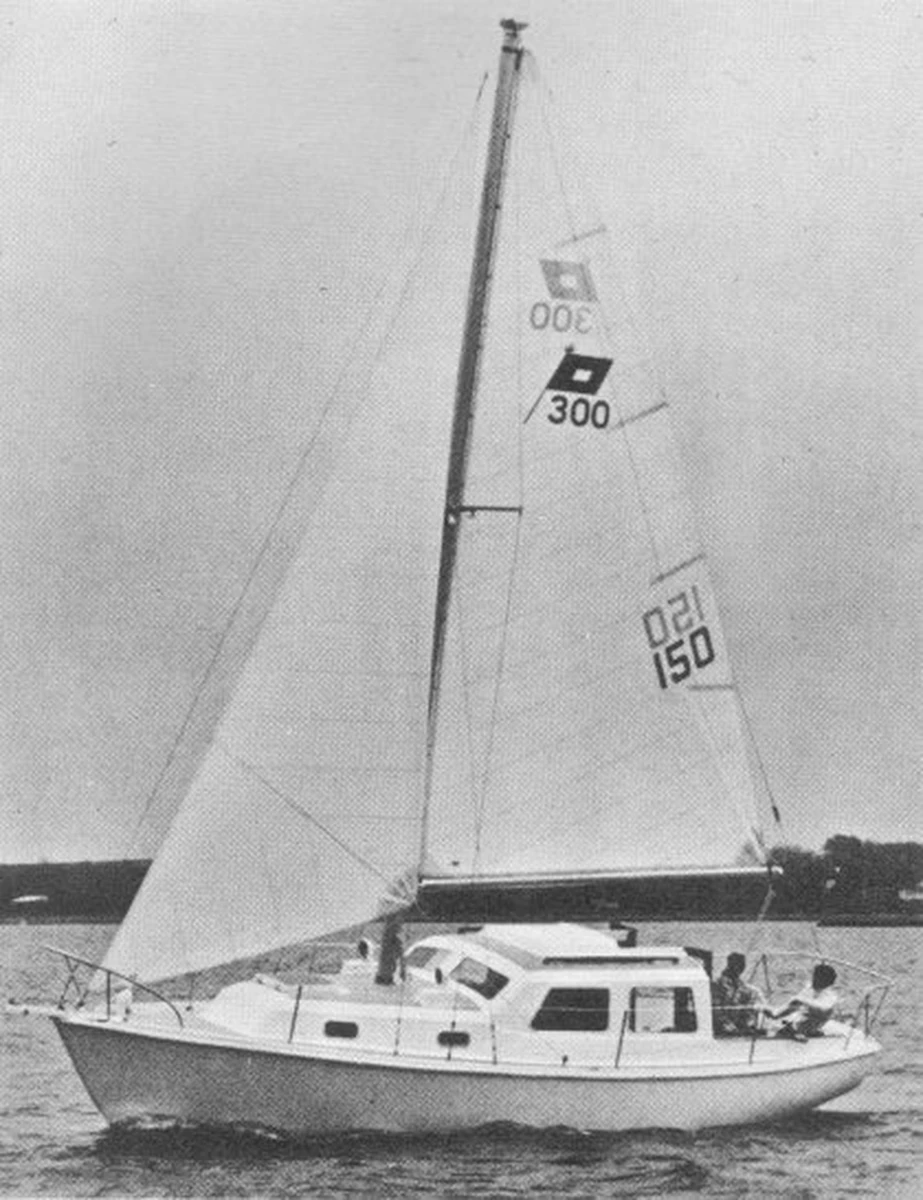
Pearson 300
Description
The Pearson 300 is a distinctive pilothouse sloop and motorsailer designed for protected coastal cruising and inland waterway exploration, offering a cozy, all-weather helm in a compact 30-foot hull. Sharing its hull with the Wanderer 30 (but without the centerboard for fixed shallow draft), it features a long keel for stability and a modest masthead sloop rig suited to light to moderate winds. Ideal for solo sailors or couples seeking shelter from rain or spray during day sails or short passages, it prioritizes comfort and simplicity over speed—think ICW or Great Lakes hops rather than offshore races. Owners value the enclosed pilothouse for visibility and warmth, spacious interior for its era, and robust fiberglass build, but note its underpowered sail plan limits performance in breezes over 15 knots. At 55+ years old, it's a niche classic for tinkerers, with a small but dedicated following. Designed by William H. Shaw in 1969, the Pearson 300 was a short-lived experiment by Pearson Yachts in Portsmouth, Rhode Island, blending motorsailer functionality with the company's cruiser heritage. Shaw, fresh from Sparkman & Stephens and early Pearson designs like the Electra, adapted the Wanderer 30 hull (a centerboard ketch) into a fixed-keel sloop with a pilothouse for all-season appeal, targeting Midwestern and protected-water sailors. Production ran only from 1969 to 1970, with an estimated 100 hulls built—a tiny fraction of Pearson's output, reflecting mixed reception to the "boxy" pilothouse amid the era's sleek racers. It preceded Shaw's longer-lived successes like the 323 and 365. No variants (e.g., cutter or open cockpit) were offered. The Pearson Yachts Owners Portal (pearsonyachts.org) and forums like Cruisers Forum provide sparse but enthusiastic support, with survivors often restored for liveaboard or charter use.
Construction Details
| Designer | William H. "Bill" Shaw |
|---|---|
| Builder | Pearson Yachts |
| Length | 30.250 ft |
| LOA | 30.250 ft |
| LWL | 23.330 ft |
| Beam | 9.250 ft |
| Displacement | 10000 lb |
| Ballast | 3800 lb |
| Max Draft | 3.500 ft |
| Year Built | 1969 |
The standard boat dimensions
| i | 31.50 ft |
|---|---|
| j | 11.33 ft |
| p | 25.67 ft |
| e | 13.08 ft |
| p2 | - |
| e2 | - |
| i2 | - |
| j2 | - |
| I | J | P | E | P2 | E2 | I2 | J2 |
|---|---|---|---|---|---|---|---|
| 31.50 ft | 11.33 ft | 25.67 ft | 13.08 ft | - | - | - | - |
Sails
Pearson 300 - MAINSAIL
| Luff | * 25.67 ft - (7824 mm) |
|---|---|
| Foot | * 13.08 ft - (3987 mm) |
| Leech | * 28.11 ft - (8568 mm) |
| Tack Angle | * 88 ° |
| Diagonal | * 28.4 ft - (8656 mm) |
| Head (inches) | * 6 in - (152 mm) |
| Area | * 173.53 ft² |
| Edit in Calculator |
Pearson 300 - JIBSAIL
| Luff | * 26.78 ft - (8163 mm) |
|---|---|
| Foot | * 15.33 ft - (4673 mm) |
| Leech | * 22.79 ft - (6946 mm) |
| Percentage LP | * 115 % |
| Length Perpendicular | * 13.03 ft - (3972 mm) |
| Deck Angle | * 12.03 ° |
| Area | * 174.44 ft² |
| Edit in Calculator |
Pearson 300 - GENOA
| Luff | * 31.8 ft - (9693 mm) |
|---|---|
| Foot | * 18.58 ft - (5663 mm) |
| Leech | * 29.66 ft - (9040 mm) |
| Percentage LP | * 150.04 % |
| Length Perpendicular | * 17 ft - (5182 mm) |
| Deck Angle | * 4.01 ° |
| Area | * 270.31 ft² |
| Edit in Calculator |
Pearson 300 - DRIFTER
| Luff | * 31.8 ft - (9693 mm) |
|---|---|
| Foot | * 19.4 ft - (5913 mm) |
| Leech | * 28.16 ft - (8583 mm) |
| Perc LP | * 150.04 % |
| Length Perp | * 17 ft - (5182 mm) |
| Deck Angle | * 9.03 ° |
| Area | * 270.28 ft² |
| Edit in Calculator |
Pearson 300 - ASYMMETRICAL
| Luff | * 31.8 ft - (9693 mm) |
|---|---|
| Foot | * 18.69 ft - (5697 mm) |
| Leech | * 29.26 ft - (8918 mm) |
| Perc LP | * 165 % |
| Area | * 446 ft² |
| Edit in Calculator |
Pearson 300 - STORMJIB
| Luff | * 18.41 ft - (5611 mm) |
|---|---|
| Foot | * 8.72 ft - (2658 mm) |
| Leech | * 14.63 ft - (4459 mm) |
| Perc LP | * 60.02 % |
| Length Perp | * 6.8 ft - (2073 mm) |
| Deck Angle | * 18.96 ° |
| Area | * 62.61 ft² |
| Edit in Calculator |
Disclaimer. Boats are not all the same -- even when produced in the same factory of the same model. Sailrite does its best to publish accurate dimensions, but we often find it worthwhile to have our customers measure their boats carefully before we produce kits for them. You should take the same precautions, especially when the data is not from Sailrite. The information on this site is not guaranteed to be accurate. Sailrite offers this content as a service to our community, but takes no responsibility for the reliability of the data provided.
Comments


