

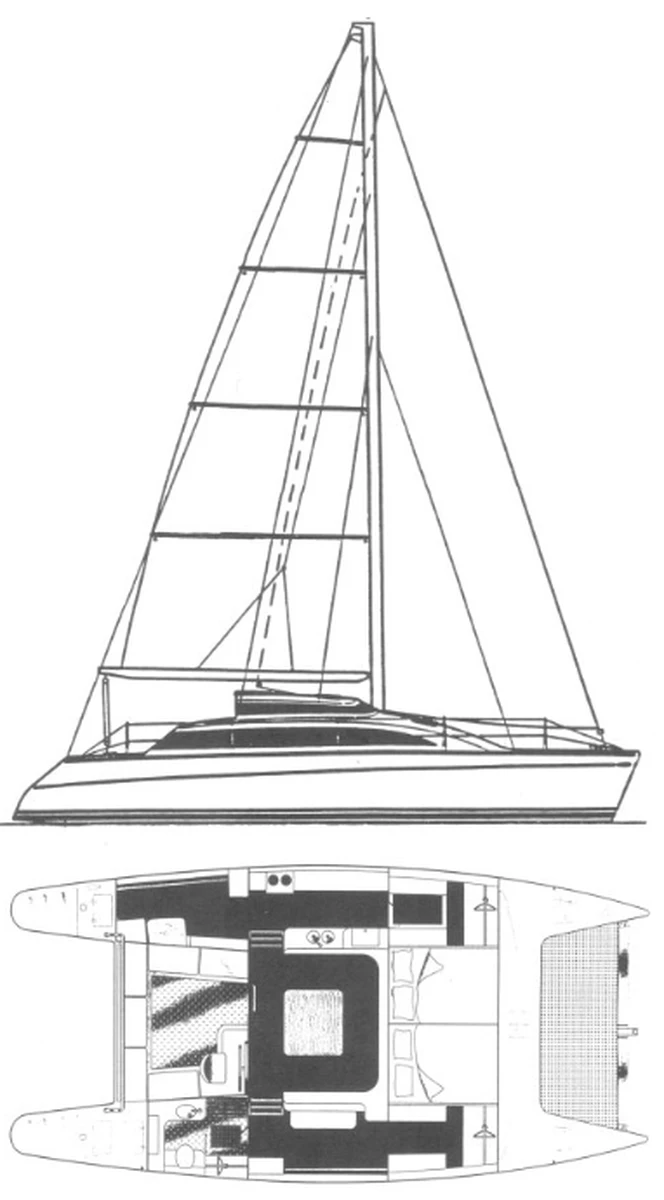
PDQ 36
Description
The PDQ 36 is a popular lightweight cruising catamaran designed by Alan Slater (with some sources crediting Ted Clements in related contexts) and built by PDQ Yachts Inc. (Whitby, Ontario, Canada) from 1991 to 2003. It features vacuum-bagged fiberglass construction with Core-Cell foam core (plus triaxial cloth and carbon fiber reinforcements in key areas like the main beam for strength and reduced weight), twin mini-keels (no daggerboards for simplicity and low maintenance), a fractional sloop rig (masthead sloop in most examples), twin outboard engines (typically 2 × 9.9 hp, with some LRC variants using inboard diesels), sugar-scoop transoms (added in the 1991 hull extension from the earlier PDQ 34/36 prototype), and a bridgedeck layout with bright, open accommodations (two hull cabins, salon with good headroom up to ~6'11", galley, and protection in the cockpit). Evolved into variants like the Mark II Classic and Mark II LRC (Long Range Cruiser with increased tankage and inboards), it was designed as a performance-oriented yet family-friendly pocket cruiser—nimble, quick to accelerate, good upwind (tacking through <90° with proper setup), shorthanded-friendly, and capable for coastal/bluewater use with excellent value and build quality. Production totaled around 100 hulls (one of the most successful North American cruising catamarans of its era), now long out of production (PDQ sailboat division transitioned to Antares Yachts in 2003), but with a strong used-market presence, owner forums, and reputation for lively sailing, comfort, and reliability.
Construction Details
| Designer | Alan Slater |
|---|---|
| Builder | PDQ Yachts (Whitby, Ontario) |
| Length | 36.420 ft |
| LOA | 36.420 ft |
| LWL | 34.330 ft |
| Beam | 18.250 ft |
| Displacement | 8000 lb |
| Max Draft | 2.820 ft |
| Year Built | 1991 |
The standard boat dimensions
| i | 41.01 ft |
|---|---|
| j | 12.53 ft |
| p | 35 ft |
| e | 13.75 ft |
| p2 | - |
| e2 | - |
| i2 | - |
| j2 | - |
| I | J | P | E | P2 | E2 | I2 | J2 |
|---|---|---|---|---|---|---|---|
| 41.01 ft | 12.53 ft | 35 ft | 13.75 ft | - | - | - | - |
Sails
PDQ 36 - MAINSAIL
| Luff | * 35 ft - (10668 mm) |
|---|---|
| Foot | * 13.75 ft - (4191 mm) |
| Leech | * 36.87 ft - (11238 mm) |
| Tack Angle | * 88 ° |
| Diagonal | * 37.15 ft - (11323 mm) |
| Head (inches) | * 6 in - (152 mm) |
| Area | * 248.15 ft² |
| Edit in Calculator |
PDQ 36 - JIBSAIL
| Luff | 39.5 ft - (12040 mm) |
|---|---|
| Foot | 19.17 ft - (5843 mm) |
| Leech | 36 ft - (10973 mm) |
| Percentage LP | * 139.03 % |
| Length Perpendicular | * 17.42 ft - (5310 mm) |
| Deck Angle | * 7.66 ° |
| Area | * 344.09 ft² |
| Edit in Calculator |
PDQ 36 - GENOA
| Luff | 39.5 ft - (12040 mm) |
|---|---|
| Foot | 10.5 ft - (3200 mm) |
| Leech | 34.5 ft - (10516 mm) |
| Percentage LP | * 68.32 % |
| Length Perpendicular | * 8.56 ft - (2609 mm) |
| Deck Angle | * 18.39 ° |
| Area | * 169.08 ft² |
| Edit in Calculator |
PDQ 36 - GENOA
| Luff | 39.5 ft - (12040 mm) |
|---|---|
| Foot | 18 ft - (5486 mm) |
| Leech | 35.75 ft - (10897 mm) |
| Percentage LP | * 129.93 % |
| Length Perpendicular | * 16.28 ft - (4962 mm) |
| Deck Angle | * 8.24 ° |
| Area | * 321.58 ft² |
| Edit in Calculator |
PDQ 36 - GENOA
| Luff | * 40.74 ft - (12418 mm) |
|---|---|
| Foot | * 20.13 ft - (6136 mm) |
| Leech | * 38.45 ft - (11720 mm) |
| Percentage LP | * 150.04 % |
| Length Perpendicular | * 18.8 ft - (5730 mm) |
| Deck Angle | * 3.96 ° |
| Area | * 382.93 ft² |
| Edit in Calculator |
PDQ 36 - ASYMMETRICAL
| Luff | 47 ft - (14326 mm) |
|---|---|
| Foot | 25.5 ft - (7772 mm) |
| Leech | 44 ft - (13411 mm) |
| Perc LP | * 165 % |
| Area | * 899 ft² |
| Edit in Calculator |
PDQ 36 - ASYMMETRICAL
| Luff | 43 ft - (13106 mm) |
|---|---|
| Foot | 25.75 ft - (7849 mm) |
| Leech | 39 ft - (11887 mm) |
| Perc LP | * 165 % |
| Area | * 830 ft² |
| Edit in Calculator |
Disclaimer. Boats are not all the same -- even when produced in the same factory of the same model. Sailrite does its best to publish accurate dimensions, but we often find it worthwhile to have our customers measure their boats carefully before we produce kits for them. You should take the same precautions, especially when the data is not from Sailrite. The information on this site is not guaranteed to be accurate. Sailrite offers this content as a service to our community, but takes no responsibility for the reliability of the data provided.
Comments


