

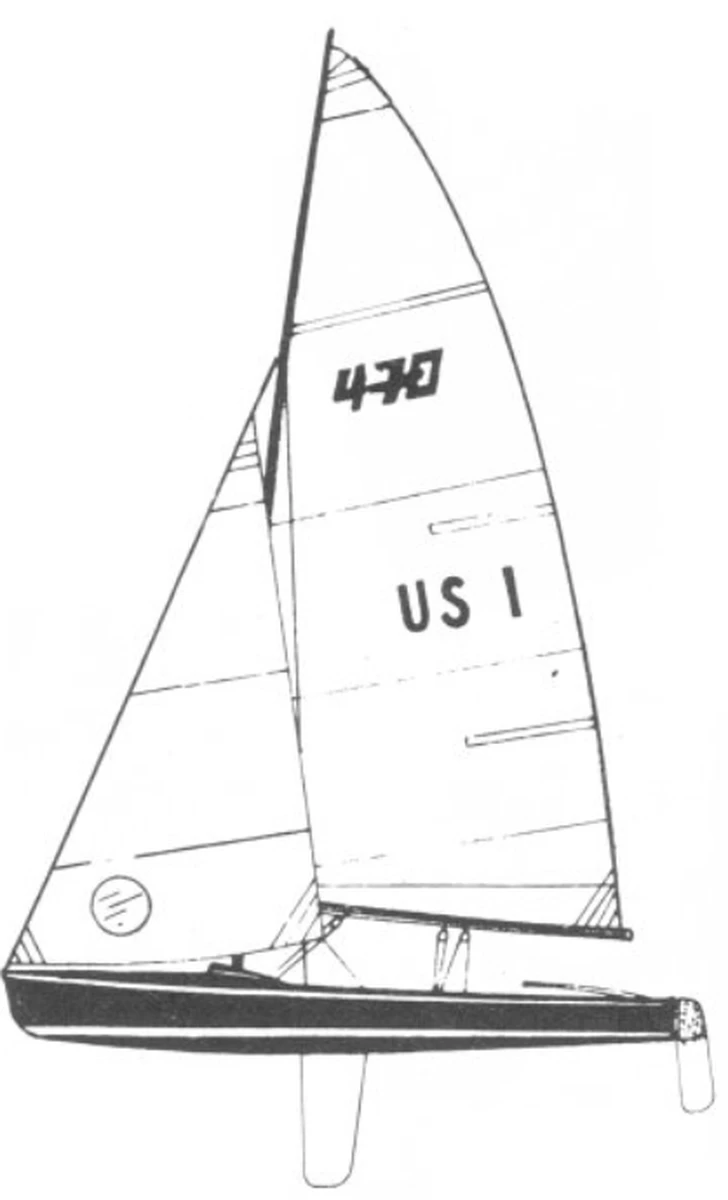
International 470
Description
The International 470 is a 4.70 m (15 ft 5 in) high-performance, double-handed, trapeze-and-spinnaker dinghy designed in 1963 by Frenchman André Cornu as a lightweight, planing successor to the Olympic Flying Dutchman, quickly becoming one of the most successful and enduring Olympic classes in sailing history. With its narrow 1.69 m beam, 100 kg minimum hull weight (fiberglass with foam-sandwich construction), twin trapezes, 12.7 m² mainsail + jib, and massive 15 m² asymmetric spinnaker flown from a retractable prod, the 470 has an extraordinarily high power-to-weight ratio that allows it to plane upwind in 12–14 knots and exceed 20 knots downwind—demanding athleticism, perfect crew coordination, and constant trimming. First selected as an Olympic class for the 1976 Montreal Games (men’s division) and adding a women’s event in 1988, it has remained the Olympic two-person dinghy ever since (mixed-gender event from Paris 2024 onward), producing legends such as Australia’s Malcolm Page, Brazil’s Kahena Kunze & Martine Grael, and Britain’s Hannah Mills. Over 40,000 boats have been built by a dozen World Sailing-licensed builders (Mackay, Ziegelmayer, Faccenda, and others), with active professional and junior fleets in more than 80 countries; strict one-design rules and continuous small refinements (carbon masts since 2008, larger kites, etc.) keep the 470 at the cutting edge of dinghy racing while remaining accessible to university teams and ambitious youth sailors worldwide.
Construction Details
| Designer | André Cornu |
|---|---|
| Builder | Vangard Sailboats (USA) |
| Length | 15.500 ft |
The standard boat dimensions
| i | - |
|---|---|
| j | - |
| p | - |
| e | - |
| p2 | - |
| e2 | - |
| i2 | - |
| j2 | - |
| I | J | P | E | P2 | E2 | I2 | J2 |
|---|---|---|---|---|---|---|---|
| - | - | - | - | - | - | - | - |
Documents
Sails
International 470 - MAINSAIL
| Luff | 18.86 ft - (5749 mm) |
|---|---|
| Foot | 8.69 ft - (2649 mm) |
| Leech | * 20.22 ft - (6163 mm) |
| Tack Angle | * 87.58 ° |
| Diagonal | 20.43 ft - (6227 mm) |
| Head (inches) | 4.5 in - (114 mm) |
| Area | * 85.03 ft² |
| Edit in Calculator |
International 470 - JIBSAIL
| Luff | 13.45 ft - (4100 mm) |
|---|---|
| Foot | 6.4 ft - (1951 mm) |
| Leech | 11.97 ft - (3648 mm) |
| Length Perpendicular | * 5.69 ft - (1734 mm) |
| Area | * 38.29 ft² |
| Edit in Calculator |
International 470 - SPINNAKER
| Stays | 14.27 ft - (4349 mm) |
|---|---|
| MidGirth | 9.84 ft - (2999 mm) |
| Foot | 11.81 ft - (3600 mm) |
| Area | * 143 ft² |
| Edit in Calculator |
Disclaimer. Boats are not all the same -- even when produced in the same factory of the same model. Sailrite does its best to publish accurate dimensions, but we often find it worthwhile to have our customers measure their boats carefully before we produce kits for them. You should take the same precautions, especially when the data is not from Sailrite. The information on this site is not guaranteed to be accurate. Sailrite offers this content as a service to our community, but takes no responsibility for the reliability of the data provided.
Comments


