

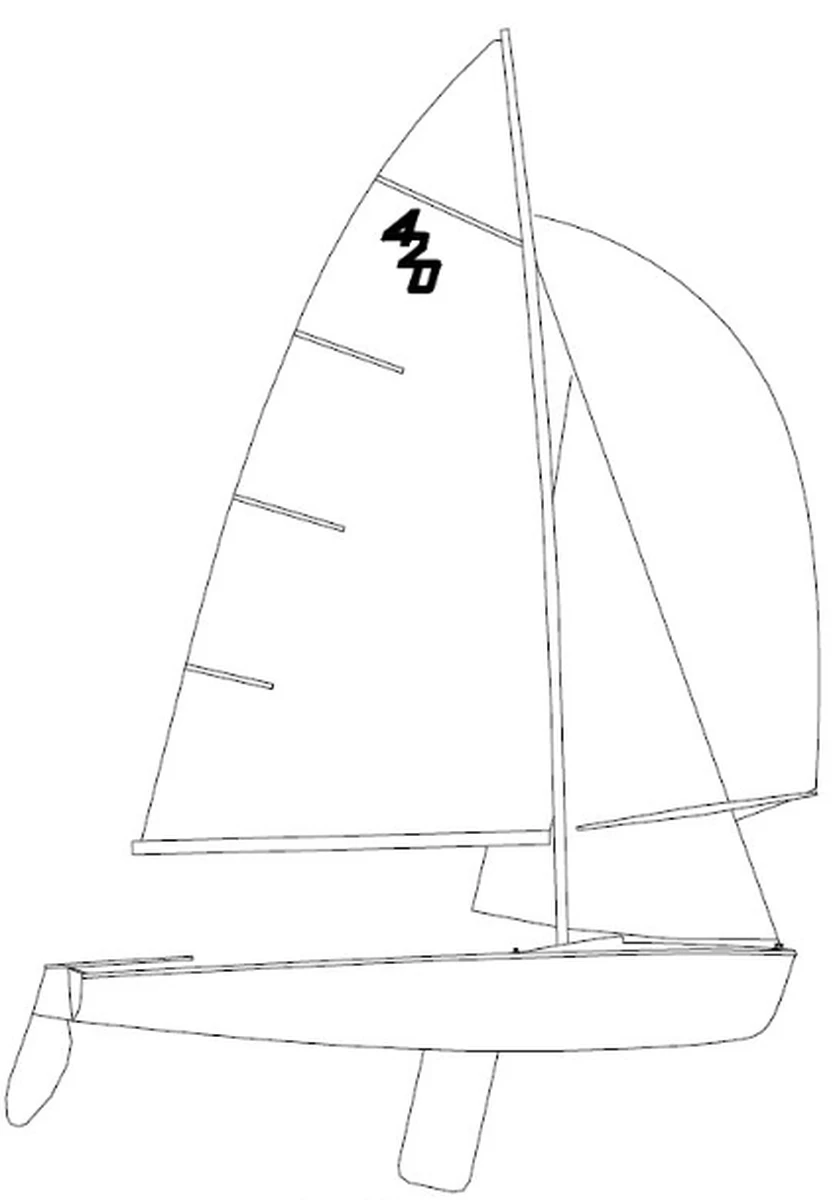
International 420
Description
The International 420 (often simply called the 420) is a fiberglass double-handed planing dinghy designed by French engineer Christian Maury in 1959 as an accessible stepping-stone to the larger Olympic-class 470, quickly gaining worldwide popularity for youth racing and training with over 32,000 hulls built since its debut. Measuring exactly 4.2 meters (13 ft 9 in) in length with a narrow 1.83 m (6 ft) beam and lightweight 175 kg (386 lb.) hull featuring internal buoyancy tanks, the Bermuda-rigged sloop boasts a high sail-area-to-displacement ratio—total upwind sail of about 15.2 m² (164 sq ft) from mainsail and jib, plus a 10.6 m² (114 sq ft) symmetric spinnaker—for exhilarating speeds that allow it to plane easily in moderate winds, supported by trapezes for the crew and a centerboard for upwind performance. Crewed by two youth sailors (typically juniors aged 12–18), it emphasizes coordination, hiking, and advanced techniques like spinnaker handling while remaining forgiving for beginners, with strict one-design rules ensuring fair competition; it's recognized as an International class by World Sailing and serves as the official boat for boys' and girls' two-person dinghy events at the Youth Sailing World Championships and national youth regattas in 43 countries. Active fleets thrive globally through the International 420 Class Association, which organizes continental championships and promotes it as a durable, fun platform for developing sailors, blending affordability (used boats often under $5,000) with high-level racing potential that has produced generations of top Olympic competitors.
Construction Details
| Designer | Christian Maury |
|---|---|
| Builder | Vangard Sailboats (USA) |
| Length | 13.750 ft |
The standard boat dimensions
| i | - |
|---|---|
| j | - |
| p | - |
| e | - |
| p2 | - |
| e2 | - |
| i2 | - |
| j2 | - |
| I | J | P | E | P2 | E2 | I2 | J2 |
|---|---|---|---|---|---|---|---|
| - | - | - | - | - | - | - | - |
Documents
Sails
International 420 - MAINSAIL
| Luff | 16.07 ft - (4898 mm) |
|---|---|
| Foot | 7.87 ft - (2399 mm) |
| Leech | * 17.49 ft - (5331 mm) |
| Tack Angle | * 88.52 ° |
| Diagonal | 17.71 ft - (5398 mm) |
| Head (inches) | 4.5 in - (114 mm) |
| Area | * 65.88 ft² |
| Edit in Calculator |
International 420 - JIBSAIL
| Luff | 11.48 ft - (3499 mm) |
|---|---|
| Foot | 5.74 ft - (1750 mm) |
| Leech | 10.5 ft - (3200 mm) |
| Length Perpendicular | * 5.23 ft - (1594 mm) |
| Area | * 30 ft² |
| Edit in Calculator |
International 420 - SPINNAKER
| Stays | 13.12 ft - (3999 mm) |
|---|---|
| MidGirth | 7.28 ft - (2219 mm) |
| Foot | 9.32 ft - (2841 mm) |
| Area | * 104 ft² |
| Edit in Calculator |
Disclaimer. Boats are not all the same -- even when produced in the same factory of the same model. Sailrite does its best to publish accurate dimensions, but we often find it worthwhile to have our customers measure their boats carefully before we produce kits for them. You should take the same precautions, especially when the data is not from Sailrite. The information on this site is not guaranteed to be accurate. Sailrite offers this content as a service to our community, but takes no responsibility for the reliability of the data provided.
Comments


