

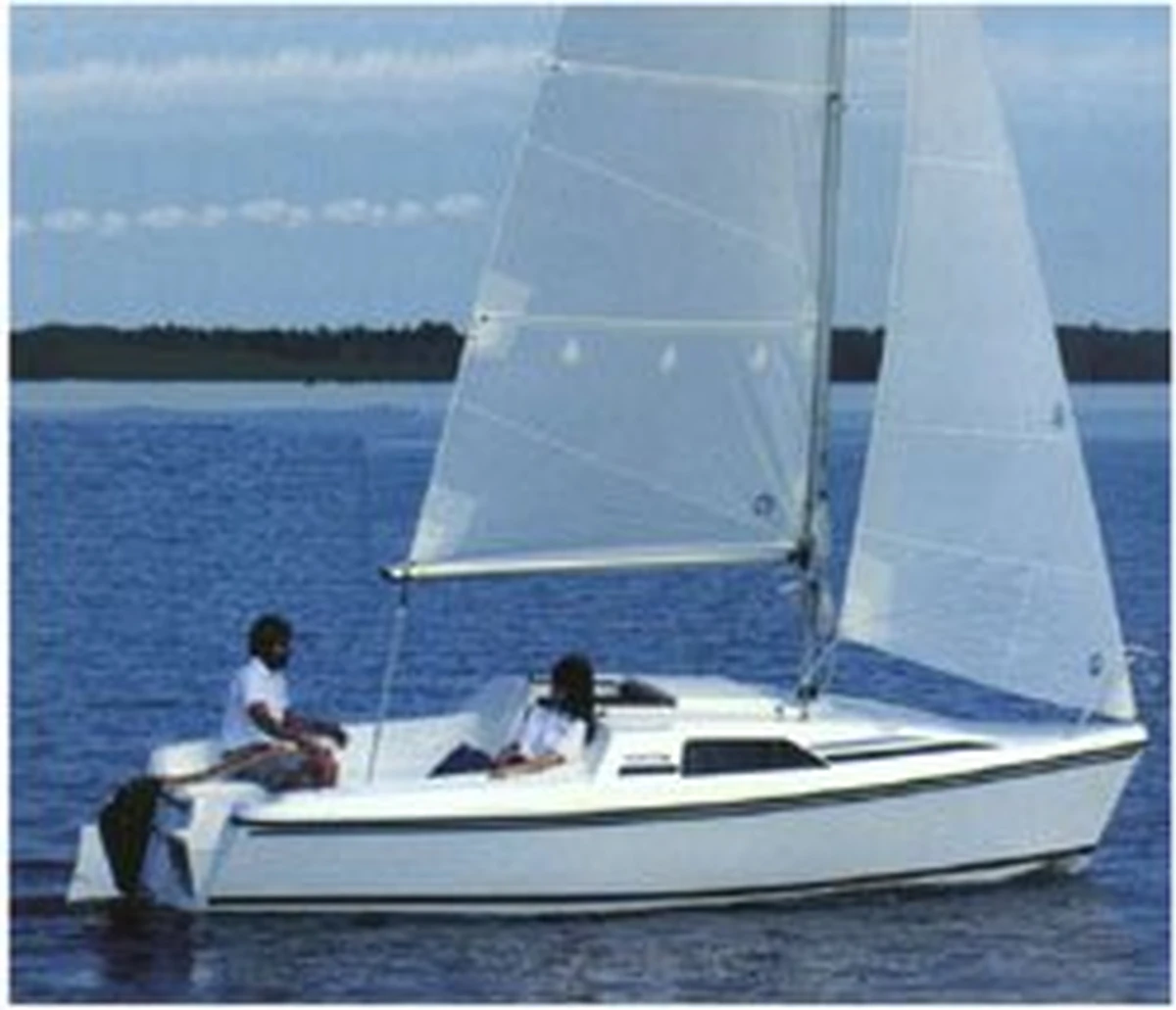
Hunter 18.5
Description
The Hunter 18.5 is an American trailerable daysailer/cruiser designed by the Hunter Design Team and built by Hunter Marine from 1988 to 1993, with well over 1,000 hulls produced. At 18 feet 5 inches LOA with a generous 7-foot 6-in. beam and a lightweight hull of just 1,350 lbs (550 lbs ballast in the winged shoal keel), it was created as a modern, roomy, and exceptionally easy-to-sail alternative to the Catalina 18 and Precision 18. It features a fractional sloop rig with a fully battened mainsail (approximately 110 sq ft) and a 150% roller-furling genoa (total upwind ~170 sq ft), an anodized mast stepped on deck for easy raising, a kick-up rudder, and a swing keel that draws only 2 feet retracted (perfect for beaching or ramp launching) and 4 feet 2 inches down. The surprisingly spacious open-plan interior offers two full-length berths, two shorter quarter berths, a portable head, and a small sink, comfortably sleeping a family of four. With positive foam flotation, a self-bailing cockpit, and simple single-handed rigging, the Hunter 18.5 became a hugely popular entry-level boat for lakes and protected coastal waters, and it still enjoys strong owner support and active one-design racing in parts of the Midwest and Southeast today.
Construction Details
| Designer | Hunter Marine |
|---|---|
| Builder | Hunter Marine (USA) |
| Length | 18.000 ft |
| LOA | 18.420 ft |
| LWL | 15.500 ft |
| Beam | 7.080 ft |
| Displacement | 1600 lb |
| Max Draft | 2.000 ft |
The standard boat dimensions
| i | 21.42 ft |
|---|---|
| j | 6.50 ft |
| p | 21 ft |
| e | 7.92 ft |
| p2 | - |
| e2 | - |
| i2 | - |
| j2 | - |
| I | J | P | E | P2 | E2 | I2 | J2 |
|---|---|---|---|---|---|---|---|
| 21.42 ft | 6.50 ft | 21 ft | 7.92 ft | - | - | - | - |
Sails
Hunter 18.5 - MAINSAIL
| Luff | * 21 ft - (6401 mm) |
|---|---|
| Foot | * 7.92 ft - (2414 mm) |
| Leech | * 22.02 ft - (6712 mm) |
| Tack Angle | * 88 ° |
| Diagonal | * 22.18 ft - (6760 mm) |
| Head (inches) | * 3.5 in - (89 mm) |
| Area | * 85.8 ft² |
| Edit in Calculator |
Hunter 18.5 - JIBSAIL
| Luff | 20.5 ft - (6248 mm) |
|---|---|
| Foot | 9.167 ft - (2794 mm) |
| Leech | 19 ft - (5791 mm) |
| Percentage LP | * 130.31 % |
| Length Perpendicular | * 8.47 ft - (2582 mm) |
| Deck Angle | * 5.53 ° |
| Area | * 86.87 ft² |
| Edit in Calculator |
Hunter 18.5 - JIBSAIL
| Luff | 21 ft - (6401 mm) |
|---|---|
| Foot | 7 ft - (2134 mm) |
| Leech | 18 ft - (5486 mm) |
| Percentage LP | * 88.92 % |
| Length Perpendicular | * 5.78 ft - (1762 mm) |
| Deck Angle | * 17.5 ° |
| Area | * 60.66 ft² |
| Edit in Calculator |
Hunter 18.5 - GENOA
| Luff | * 21.27 ft - (6483 mm) |
|---|---|
| Foot | * 10.44 ft - (3182 mm) |
| Leech | * 20.07 ft - (6117 mm) |
| Percentage LP | * 150 % |
| Length Perpendicular | * 9.75 ft - (2972 mm) |
| Deck Angle | * 4.04 ° |
| Area | * 103.71 ft² |
| Edit in Calculator |
Hunter 18.5 - GENOA
| Luff | 20.25 ft - (6172 mm) |
|---|---|
| Foot | 9.42 ft - (2871 mm) |
| Leech | 19.083 ft - (5816 mm) |
| Percentage LP | * 135.54 % |
| Length Perpendicular | * 8.81 ft - (2685 mm) |
| Deck Angle | * 3.78 ° |
| Area | * 89.24 ft² |
| Edit in Calculator |
Hunter 18.5 - ASYMMETRICAL
| Luff | 21.75 ft - (6629 mm) |
|---|---|
| Foot | 11 ft - (3353 mm) |
| Leech | 19.75 ft - (6020 mm) |
| Perc LP | * 165 % |
| Area | * 179 ft² |
| Edit in Calculator |
Hunter 18.5 - SPINNAKER
| Stays | * 21.27 ft - (6483 mm) |
|---|---|
| MidGirth | * 11.7 ft - (3566 mm) |
| Foot | * 11.7 ft - (3566 mm) |
| Perc LP | * 180 % |
| Area | * 212 ft² |
| Edit in Calculator |
Disclaimer. Boats are not all the same -- even when produced in the same factory of the same model. Sailrite does its best to publish accurate dimensions, but we often find it worthwhile to have our customers measure their boats carefully before we produce kits for them. You should take the same precautions, especially when the data is not from Sailrite. The information on this site is not guaranteed to be accurate. Sailrite offers this content as a service to our community, but takes no responsibility for the reliability of the data provided.
Comments


