

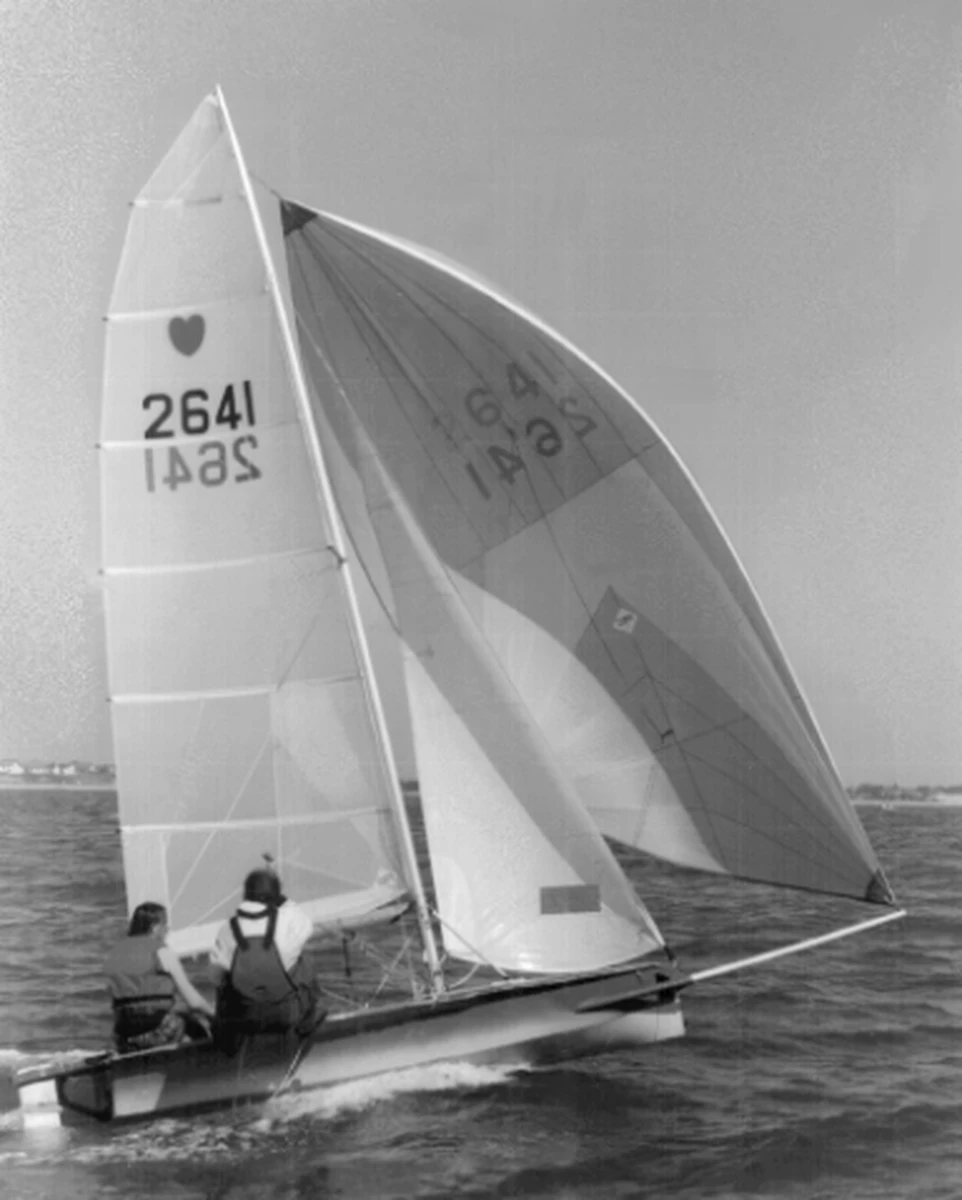
Cherub (Development Class)
Description
The Cherub is a high-performance 12-foot two-person planing dinghy first designed in 1951 in New Zealand by John Spencer (originally for friend Ray Early to race in the restricted Pennant class on Auckland Harbour; the first hull was built by Early himself in hard-chine 3/16-inch plywood). It proved an instant success, promoted heavily by Sea Spray magazine with construction plans and registration, leading to roughly 450 boats built in New Zealand in the first eight years alone; the class spread to the UK (first manufacturer McCutcheon’s of Cowes, 1956) and Australia (1960), with the Cherub Class International Association formed in 1967 and the first Worlds held in Perth in 1970. As a development (box-rule) class with no single production builder, hulls evolved from early plywood (later foam sandwich pioneered by Russell Bowler) to modern carbon/glass composites while maintaining a minimum hull weight; key features include exceptional power-to-weight ratio, spectacular planing (upwind and off wind), asymmetric spinnaker (from 1991, with bowsprit), twin trapezes (approved 2004), self-draining cockpits in later designs, and rule-driven hull/rig variations (narrower flatter shapes in UK vs. Southern Hemisphere) that keep it fast, exciting, and garage-buildable.
Construction Details
| Designer | John Spencer |
|---|---|
| Builder | Home Built |
| Length | 12.160 ft |
| LOA | 12.160 ft |
| Beam | 5.920 ft |
| Displacement | 110 lb |
| Year Built | 1951 |
The standard boat dimensions
| i | - |
|---|---|
| j | - |
| p | - |
| e | - |
| p2 | - |
| e2 | - |
| i2 | - |
| j2 | - |
| I | J | P | E | P2 | E2 | I2 | J2 |
|---|---|---|---|---|---|---|---|
| - | - | - | - | - | - | - | - |
Documents
Disclaimer. Boats are not all the same -- even when produced in the same factory of the same model. Sailrite does its best to publish accurate dimensions, but we often find it worthwhile to have our customers measure their boats carefully before we produce kits for them. You should take the same precautions, especially when the data is not from Sailrite. The information on this site is not guaranteed to be accurate. Sailrite offers this content as a service to our community, but takes no responsibility for the reliability of the data provided.
Comments


