

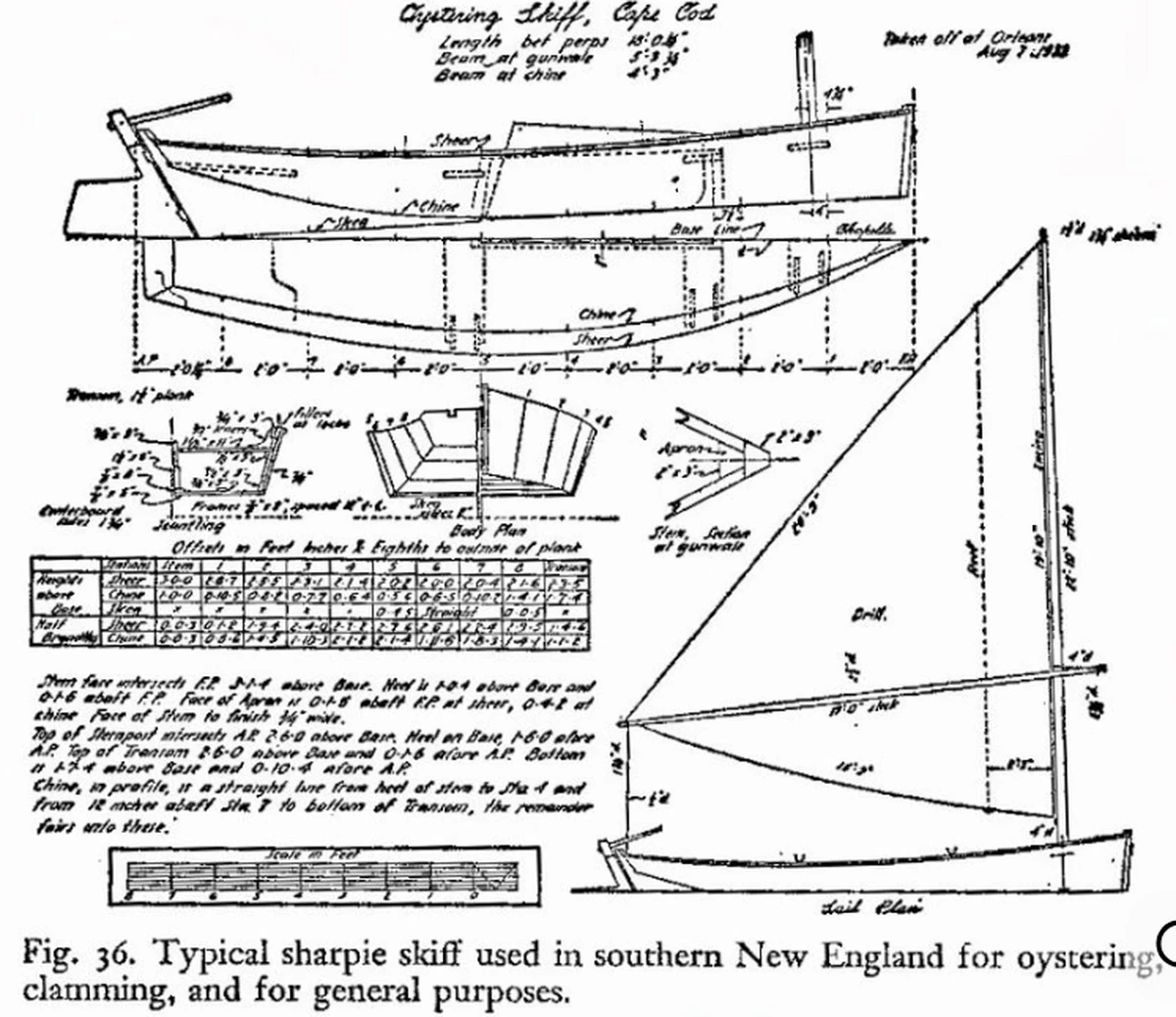
Cape Cod Oystering Skiff 18
Description
The Cape Cod Oystering Skiff 18 by Howard I. Chapelle refers to a historic 18-foot flat-bottomed sharpie workboat documented in his seminal book American Small Sailing Craft: Their Design, Development and Construction (W.W. Norton, 1951), specifically on page 101. Chapelle recorded this as a typical example of the narrow, lightweight skiffs used by oystermen on Cape Cod in the late 19th/early 20th centuries for working shallow tidal flats, sandbars, and protected bays—poling, rowing, or sailing to harvest oysters with tongs or rakes. These were practical, no-frills workboats: fast in thin water, easy to build from local lumber (often cedar or cypress planking on simple frames), and optimized for one-person operation in variable conditions. Chapelle's drawing captures a classic flat-bottom sharpie hull with sharp entry bow, raked transom, centerboard (or pivoting daggerboard), and a simple unstayed spritsail or leg-o'-mutton rig for light winds and quick reefing (by drawing the sail to the mast). The design emphasizes speed over load-carrying compared to beamier catboats, with minimal freeboard and a fine run aft for efficiency.
Construction Details
| Designer | Howard I. Chapelle |
|---|---|
| Length | 18.000 ft |
| Beam | 5.000 ft |
| Year Built | 1900 |
The standard boat dimensions
| i | - |
|---|---|
| j | - |
| p | - |
| e | - |
| p2 | - |
| e2 | - |
| i2 | - |
| j2 | - |
| I | J | P | E | P2 | E2 | I2 | J2 |
|---|---|---|---|---|---|---|---|
| - | - | - | - | - | - | - | - |
Sails
Cape Cod Oystering Skiff 18 - LEG-O-MUTTON
| Luff | 19.85 ft - (6050 mm) |
|---|---|
| Foot | 15.25 ft - (4648 mm) |
| Leech | * 19.91 ft - (6069 mm) |
| Tack Angle | * 69.04 ° |
| Diag (clew/head) | 20.25 ft - (6172 mm) |
| Head (Inches) | * 6 |
| Area | * 145.03 ft² |
| Edit in Calculator |
Disclaimer. Boats are not all the same -- even when produced in the same factory of the same model. Sailrite does its best to publish accurate dimensions, but we often find it worthwhile to have our customers measure their boats carefully before we produce kits for them. You should take the same precautions, especially when the data is not from Sailrite. The information on this site is not guaranteed to be accurate. Sailrite offers this content as a service to our community, but takes no responsibility for the reliability of the data provided.
Comments


